
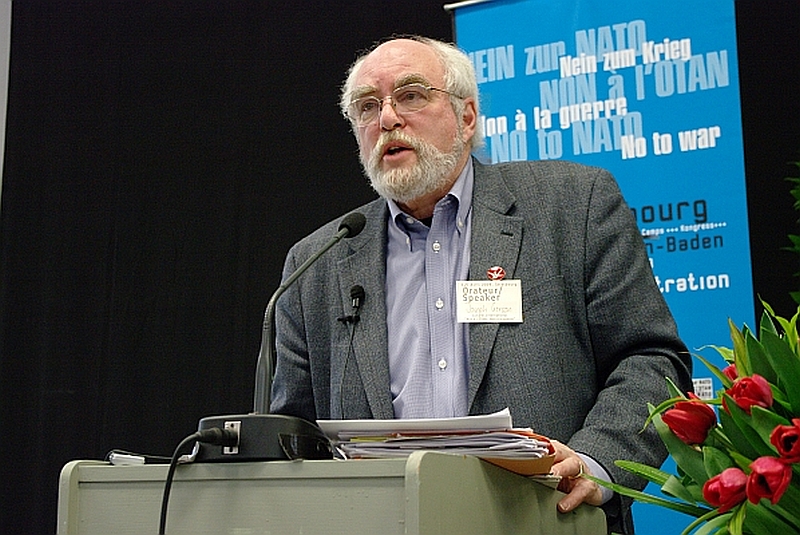
Joseph Gerson is disarmament
coordinator of the American Friends Service Committee
and director of programs for AFSC in New England. He works closely with Asian,
European and other international peace and justice movements. His most recent
book is Empire and the Bomb: How the US Uses Nuclear Weapons to Dominate the
World.
TRUTH TO THE EMPIRE:
JOE GERSON SPEECH AT
STOCKHOLM:
Dr Joseph Gerson, a leading Peace Activist in the USA will deliver this speech in Stockholm, Sweden, Saturday, September 14, 2013:
Recall,
too, that not only the majority of U.S. voters, but, hundreds of thousands of
people in Berlin on the eve of the 2008 U.S. election and even the Nobel Peace
Prize Committee had great hopes – and certainly as many illusions -- about what
Barack Obama would achieve as president.
Like 1976,
when the Rockefeller funded Trilateral Commission put Jimmy Carter forward as
the benign face of the United States in the wake of the Nixon-Kissinger
savaging of Indochina and Nixon’s assault on the foundations of U.S. democracy
known as the Watergate affair. Carter – who has been a much better ex-President
than he was president - was to be a new face with new rhetoric that could
overcome the world’s perception of the United States as a pariah nation. In
2008 many celebrated not only Obama’s election and that the U.S. people had so
overcome its racial apartheid history that it could elect a man of color as
president. Too few understood how deep his ties were to Wall Street and to the
U.S. power elite or paid attention when he said that Iraq was the wrong war,
not that war itself is wrong.
In the past year he has spoken on U.S. foreign and military policy issues across New England and the United States and in Goteborg, Sweden, Hiroshima and Nagasaki, Japan, Seoul, Korea. His article "The Politics and Geopolitics of Missile Defences" appeared in the July/August edition of Z Magazine. His books include: With Hiroshima Eyes: Atomic War, Nuclear Extortion and Moral Imagination; The Deadly Connection: Nuclear War and U.S. Intervention, and The Sun Never Sets...Confronting the Network of U.S. Foreign Military Bases.
Joseph Gerson was a student activist at Georgetown University, where he engaged with the civil rights and peace movements. He became a draft resister and participated in the 1967 March on the Pentagon, protests around the 1968 Chicago Democratic Party Convention, directed Arizonans for Peace (1969-73), served on the staff of Clergy & Laity Concerned About Vietnam (1970-73), and as Staff Coordinator of the War Resisters International in London & Brussels (1973-75.)
To
Swedish participants, I want to say that I am sorry that the U.S. president
preceded me here as part of his drive toward war with Syria and to bring Sweden
into NATO. There is no pleasure in speaking as critically as I must about the
government that acts in my name. Truth is the foundation of freedom and
ultimately of security, so we must look as hard and speak as clearly about
reality as we can. I trust that you know
that two thirds of the U.S. public have opposed Obama’s plan to attack Syria.
The Grand Chessboard: American Primacy And Its Geostrategic
Imperatives
For
the moment, we are back from the brink of yet another U.S. war in the Middle
East and what seemed to be a career shattering defeat for President Obama in
Congress. Obama’s threat to launch
missile and bombing attacks against Syria still stand. He argues that it was
that threat that led to the Russian-Syrian agreement, and that he must continue
the credible threat of deadly attacks to assure an agreement that meets his
demands is fulfilled. In a peculiar way, this may in fact strengthen his hand
with Congress, making it more willing to endorse attacks if a satisfactory
agreement cannot be reached and is not fully implemented. On a roll, some in
the U.S. elite are now fixing their attention on North Korea’s chemical weapons
stores. Let’s be clear, Obama threats were made in defiance of the U.N.
Charter, the Chemical Weapons Convention, with scant regard for the
International Criminal Court, for Ibrahim Brahimi’s efforts to press for a
diplomatic resolution of Syria’s civil war, or for U.S. public opinion.
As
bad as the Assad dictatorship is, I am inclined to believe that, as German
intelligence is reported to have advised Angela Merkel, Assad repeatedly
refused requests to authorize the use of chemical weapons against opposition
forces, and that the dastardly chemical attack was launched by a rogue military
unit, leading to panic within the Syrian general staff. At root, have been two
powerful dynamics: Syria’s civil war, which has
no military solution and can only be resolved with negotiations and
diplomacy and U.S. efforts to reinforce its declining Middle East hegemony. Control
of Persian Gulf oil remains the primary motive of Obama’s threats of war, but they
have been about more than oil. On August
30, Secretary of State Kerry opened the Administration’s propaganda campaign to
win public and Congressional support for war. He stressed that Obama’s red line
“matters deeply to the credibility and the future interests of the United
States of America and our allies…It is directly related to our credibility
about whether countries still believe the United States when it says something.
They are watching to see if Syria can get away with it, because then maybe they
too can put the world at greater risk.”
As
the journalist Robert Dreyfuss wrote last week, “The dirty little not-so-secret
behind President Obama’s much-lobbied-for, illegal and strategically
incompetent war against Syria is that it’s not about Syria at all. It’s about
Iran—and Israel. And it has been from the start.” When he spoke of risks and children
killed in Syria, Kerry didn’t mention the fact that the U.S. has repeatedly threatened
to initiate nuclear war - most recently the B-2 and B-52 simulated nuclear attacks
against North Korea last March – to enforce its empire. Nor
U.S. use of Agent Orange in Vietnam and depleted uranium weapons in Iraq and
Serbia. There was certainly no reference to the fact that the U.S. didn’t
attack Iraq after Saddam Hussein used chemical weapons in Halabj or to U.S.
collaboration with Saddam, providing coordinates and other resources for Iraqi
chemical weapons attacks against Iranian troops in the 1980s. And, when Obama and Kerry speak of enforcing international
norms, we’re supposed to forget the U.N. charter and U.S. drone warfare from
Yemen to the Philippines.
The
ostensible goal of the threated attacks belied their real purpose. As the president said, the U.S. had no plans
to destroy or seize Syria’s stores of chemical weapons or to oust its government.
Yes, wrapped in the rhetoric of a humanitarian intervention, military units
most likely responsible for the August 21 atrocities would be attacked, but the
war plan expanded to seriously weaken Syria’s military in order to change the balance of
forces within the Syrian civil war and to maintain credible U.S. threats
against Iran, North Korea, China and other nations.
This
is not an aberration. After the invasion
of Iraq, Paul Wolfowitz celebrated that other nations once again feared the
U.S. And many will remember that the
Pentagon Papers – the Pentagon’s secret history of U.S. Vietnam War decision-making–
revealed that 85% of the reason the United States wrought massive destruction
and death across Indochina was to maintain the “perception” of U.S. military
power.
In
addition to preparing a demonstration war to reaffirm U.S. will and coercive
power, many in the U.S. and Israeli elite are proceeding on the basis that the
U.S. loses if either of the sides in the Syrian civil war win. So, as in the
1980s, when the U.S. provided weapons, intelligence and diplomatic support at
different times to Iraq and Iran during their war, Obama’s threats have been to
weaken but not overthrow Assad, so that the war can go on. Both sides have been played against the
middle, with the goal of bleeding them until the U.S. can pick up the pieces.
But,
there is the second superpower: public opinion. A week ago New York Times columnist Charles Blow wrote that: “…one can
simultaneously express sorrow for the dead, particularly the children, and
resist direct United States military intervention. This is a false choice that
uses the dead children as a mask for America’s militaristic instinct...”
This understanding, the massive popular
mobilisation by the U.S. peace movement, the right-wing’s venal agendas, international
opposition, and as one military veteran put it “We’re tired. Can’t we find a
different way” that made it almost impossible for President Obama to get his
initial war powers resolution through Congress.
We
can now hope that in addition to resolving the immediate crisis over Syria’s
chemical weapons, that the diplomatic process it sparked will lead to
convening the promised Geneva conference
(which until now the Syrian opposition has refused to attend) and will
reinforce U.S.-Iranian negotiations for a modus vivendi, including an agreement
on Iran’s nuclear program.
I
want to focus on the foundations and the fundamental dynamics of U.S.
imperialism and how they operate. Let me begin by briefly noting the United
States’ most recent imperial scandal: Edward Snowden’s revelations confirming
that the U.S. monitors all of the world’s electronic communications and the postal
mail of every U.S. resident. As you know, this is not limited to people who
actively seek to harm my compatriots. It has included the leaders of the G-20
nations, the E.U. Mission in Washington, D.C., and even my six year-old
grandson’s phone conversations. They can now learn his dark secrets.
Ironically, Snowden’s revelations came after months of incessant U.S.
complaints about the outrages of Beijing’s cyber spying.
Since
the decline and fall of Athenian democracy, we have known that Empire and
democracy cannot coexist. We now know that in the U.S. there is a “secret body
of law” governing U.S. international and domestic spying, that even those
secret laws have been violated, and that the U.S. annually spends more than $50
billion on its so-called “intelligence” agencies. As in what the Italian anti-fascist novelist
Ignazio Silone once called “The Land of Propaganda”, blinkered by the daily
media and by cognitive dissonance, few in the U.S. have any conception of the
Deep State that lies behind the venality and daily shenanigans of many of our
elected officials and their entourages,
Nor do they think about the implications of the recent Supreme Court
decision that permits the wealthiest people and corporations – even foreign
corporations – to contribute as much money as they wish to election campaigns –
often in secret. Similarly, few can
remember yesterday’s news or connect the dots. Former President Carter, who has
been a better ex-president than president, had it right when he said in July that
“America does not at the moment have a functioning democracy. Only time and our
struggles will reveal if sufficient corrective forces within the U.S. can be
brought to bear, or if – at enormous cost to the U.S. and the world’s people –
these dynamics will worsen and inevitably lead to the implosion of the U.S.
Empire and the contours of U.S. American life as we know them.
How
have we arrived at such circumstances? I’ll try to keep it brief. Those of you
wanting greater detail about the evolution of the U.S. Empire can read the full
text of this talk or work your way through Empire and the Bomb.
I’ll
begin on a personal note. Not knowing enough to perceive obvious
contradictions, I entered Georgetown University’s School of Foreign Service in
1964 with the goals of both becoming a Civil Rights Freedom Rider and a U.S.
diplomat. I was naïve indeed, but with the Vietnam War it became almost
immediately apparent that there was no way I could represent a government that
waged a criminal war. I did join the Civil Rights movement and for reasons not
worth sharing here, I remained at Georgetown. There I was a middle class Jewish
kid, getting the same education as my classmates Bill Clinton, Gloria Macapagal
(later Macapagal-Arroyo, President of the Philippines and now an indicted
criminal,) other sons and daughters of corrupt and brutal heads of state, and
more than a few who became diplomats, intelligence officers, and businessmen.
Among the most fundamental lessons taught at Georgetown were that civilizations
– and by extension empires - function as
interdependent systems of intellectual, economic, military, social, political,
and spiritual dynamics, and that at various periods of time, one or a
combination of these factors are preeminent. Thus, without economic and intellectual
foundations, the NSA, drones and atomic weapons would not exist.
Other
lessons included the conquest and creation of the U.S. continental empire
fueled by the “Manifest Destiny” ideology as well as economic enticements, fire
power, war and genocide. We were taught the beliefs that “the study of
international relations is analogous to the rules of the games among Mafia
families” and that “international law is what those who have the power to
impose it say it is.” This is a lesson that President Clinton apparently
remembered when, in violation of the U.N. Charter, he launched the 1999 NATO
war against Serbia, a war which had little to do with humanitarian intervention
and saving Kosovars. George W. Bush and now Barack Obama have since built on
this Clinton precedent.
Professor
Jules Davids, the primary ghost writer of President Kennedy’s campaign book Profiles
in Courage, taught that in the 1850s William Seward argued that if the U.S.
were to replace Britain as the world’s dominant empire, it must first control
Asia. Davids also explained how, having built The Great Fleet that could
challenge Britain’s naval superiority and facing the turmoil and protests that
accompanied the Great Depression of the 1890s, U.S. leaders responded with the
war against Spain. The U.S. thus launched its global empire by conquering Cuba
and Puerto Rico, making it possible to dominate the Caribbean, Central America
and northern South America. As important, the Philippines and Guam were seized
and pacified, and Hawaii was annexed, all to gain the geostrategic stepping
stones to the holy grail of capitalism: the China market and its storied
millions of potential consumers.
In
addition to serving U.S. “Manifest Destiny” these conquests – especially those
in Asia and the Pacific - were designed to create “social peace” within the
United States by creating the global market that would put unemployed and often
protesting workers back to work in factories and mines that would operate 24
hours a day, while simultaneously increasing corporate profits and private
wealth. In our resistance to the Vietnam War, some of us learned from movement
elders that The Vietnam War is not an aberration, but it took time to stumble
across In 1948, Assistant Secretary of
State for Policy Planning George Kennan’s prepared a TOP SECRET memo that
advised:
We have
about 50 percent of the world’s wealth,
but only 6.3 percent of its population…. In this situation, we cannot fail to
be the object of envy and resentment. Our real task in the coming period is to
devise a pattern of relationships which will permit us to maintain this
position of disparity….We need not deceive ourselves that we can afford today
the luxury of altruism and world benefaction….We should cease to talk about
vague and unreal objectives such as human rights and, the raising of the living
standards and democratization. The day is not far off when we are going to have
to deal in straight power concepts. The less we are then hampered by idealistic
slogans, the better.
This
was said just three years after President Truman, operating out of “straight
power concepts,” had burned all of Japan’s major cities to the ground and
attacked Hiroshima and Nagasaki with atomic bombs in order to send a message to
Moscow. In the aftermath of the Cold War, Zbigniew Brzezinski wrote a primer
for his students and the U.S. elite to overcome long-standing and blinding Cold
War taboos against naming or speaking explicitly about the Empire. He thought
it necessary for them to have the conceptual frames of reference to continue
the country’s “imperial” project.
Drawing
on Mackinder and others, he taught that the nation that controls the Eurasian
heartland dominates the world, and that as an island power – like Britain when
it controlled three-quarters of the world - the U.S. must have toe-holds on
Eurasia’s Western, Southern and Eastern peripheries. Thus we had NATO in
Western Europe – designed to contain Germany as well as the Soviet Union – and
U.S. dominance in the Middle East. With the collapse of the Soviet Union and with
the Afghanistan War, Washington reached into the mineral-rich Central Asian
southern underbelly of Eurasia. To the east of Eurasia lies the “American
Lake,” the Pacific Ocean with its client states, and hundreds of U.S. military
bases from Hawaii to Japan and South Korea to Guam and the Philippines that
serve as Washington’s “unsinkable aircraft carriers.” In fact, the U.S.
maintains a global network of an estimated 1,000 foreign military bases and
installations, an infrastructure of foreign fortresses unmatched by previous
empires that have made possible U.S. wars, from Vietnam and Iraq to Serbia and
Panama, and many elements of U.S. nuclear war fighting doctrines.
The
Bush-Cheney government was anything but discrete about its imperial ambitions.
Soon after Vice-President Cheney remarked that the Bush Administration was
preparing to impose “the arrangement for the 21st century”, the cover of the Sunday New York Times Magazine
announced “The American Empire – Get Used to It”. That cover heralded an article in which a
“senior White House official” – later reported to be Karl Rove – boasted:
“We’re an empire now, and when we act, we create our own reality. And while
you’re studying that reality…we’ll act again, creating other new
realities…that’s how things will sort out. We’re history’s actors…”
That
was a time when the elite scholar Francis Fukayama had announced “the end of
history,” and neoconservatives spoke of the “unilateral moment” – revising
former Secretary of State Madeline Albright’s conceit that the U.S. was the
“indispensable nation.”
As
the country and the world recoiled from the horrors of Abu Ghraib, the
destruction of Iraq, and the cratering of the U.S. economy, we thought that era
of imperial excess had passed. The Obama
Administration seemed to promise a return to the more complex practice of multi-lateral
imperialism, renewing dependence on privileged allies – with whom it shared the
spoils - and highlighting the roles of the United Nations, the World Bank, the
IMF and other international institutions. But, after stumbling over an
ill-conceived red line, and being pressed by militarists, and encouraged by
liberal “humanitarian hawks” like U.N. Ambassador Samantha Powers and National
Security Advisor Susan Rice, we’re back to U.S. unilateralism. President Obama
and Secretary of State Kerry are singing yet another chorus of Madeleine
Albright’s, “What’s the point of having this
superb military you’re always talking about, if we can’t use it?”
There
is, in fact, the continuation of U.S. policies that can be traced to the beginning
of the United States’ overseas empire in the 1890s. Joseph Nye, who has served in the U.S.
government in many capacities, including Assistant Secretary of Defense for
International Security Affairs, and who has been a principle driver of U.S. Asia-Pacific
foreign and military policies for a generation put it this way:
“Asia will
return to its historic status, with more than half of the world’s population
and half of the world’s economic output. America must be present there. Markets
and economic power rest on political frameworks and American military power
provides that framework.”
The
New York Times columnist Thomas
Friedman described the economic and military foundations of the American way of
life more bluntly:
The hidden hand of the market will never work without a hidden fist.
McDonald's cannot flourish without McDonnell Douglas, the designer of the F-15.
And the hidden fist that keeps the world safe for Silicon Valley's technologies
to flourish is called the US Army, Air Force, Navy and Marine Corps.
Thus
we have Obama’s U.S. “Pivot” to Asia and the Pacific, with the U.S. military
buildup across the region, the reinforcement of U.S. military alliances with
Japan (whose foreign minister recently urged that his government draw on the
lessons of Nazi Germany in eviscerating the country’s peace Constitution,)
South Korea, Australia, the Philippines and Thailand which constitute “the
fulcrum for our strategic turn to the Asia-Pacific”, the deployment of 60% of
U.S. air and naval forces to the region,
deepening military-to-military cooperation with Vietnam, Indonesia and
Myanmar, and the military collaborations and tacit alliance with India.
Nye also
recognizes parallels between the current moment, 1914 and the late 1930s,
repeatedly pointing to the inevitable tensions between rising and declining
powers. With China in mind, Nye has also warned that twice during the twentieth
century the dominant powers – the U.S. and Britain – failed to integrate rising
powers – Germany and Japan – into their global systems, with the result being
two catastrophic world wars. China is thus to be engaged as well as contained.
One way to
understand the United States’ relative decline is to note that by the 1990s,
Japan and Europe had essentially recovered from World War II’s devastations and
the colonial era was little more than memory. No longer able to boast that U.S.
people were 6% of the world’s population with 50% of the world’s wealth,
President Clinton spoke of Americans being 4% of the world’s population with
22% of its wealth. With China’s extraordinary economic growth, the U.S. share
of global wealth has been further reduced.
In response,
and in addition to its military agendas, the U.S. elite are attempting to
create something along the lines of a “Greater West,” and in the early days of
the Obama Administration this vision was inclusive of Russia. Looking at the
decline in global market share of the Trilateral powers - the U.S., Europe and Japan – and thus the likely entropy of
the foundations of their industrial and military power, the U.S. is in the process of negotiating the
Transatlantic Partnership (TAP) and the Trans Pacific Partnership (TPP.) As Sergey Rogov has observed, the plan is to
place the U.S. “at the head of two ‘rings’ – two giant regional economic
coalitions….which account today for 20 percent of the world’s population, 65
percent of global GDP, and almost 70 percent of global exports.” If
successfully negotiated and implemented, these free trade agreements would
contain China’s growing economic power. Designed as “docking agreements,” that
would permit other nations to join, but only on the terms of the original
agreement, they are thus designed to fulfill Nye’s vision of integrating a
rising power into the dominant powers’ existing systems.
Before
turning briefly to NATO, the Middle East and Africa, I want to point to one
other foundation of the U.S. Empire. The scholar Alfred McCoy argues that the
U.S. empire will either simply continue its decline or, if it can extend
monopolies over the most advanced forms of intelligence and space weaponry
technologies, it could persist for several decades, even as its economic and
political systems rot from within.
McCoy traces
the foundations of the modern Philippine and U.S. states to the conquest of the
Philippines and the repression of its nationalist movement between 1898 and
1901. He explains that this was done with the most advanced intelligence
technologies of the day: telephone, telegraph, typewriter and the Dewey decimal
system for data management, as well as by the parallel development of the
Philippine Constabulary, a paramilitary force. The FBI and other U.S. agencies then
put these technologies to work within the U.S. to disrupt and defeat popular
forces seeking economic and social justice. The second generation of these
technologies was developed during WW II and the Vietnam War, including the
so-called “electronic battlefield” and the precursors of cruise missiles. We see their current manifestations in Edward
Snowden’s revelations and in the deep integration of space and military
technologies for everything from operating drones and targeting for U.S.
missiles to naval and counter-insurgency warfare.
Although successive U.S. Secretaries of Defence/War have raised deep
concerns about NATO and its future, especially comparatively low levels of
European military spending, as Brzezinski wrote, NATO has provided the means to
ensure "the United States [as] a key participant even in inter-European
affairs." European allies are seen as "vassal states," whose
elites provide hundreds of military bases and installations, diplomatic
support, co-production of weapons systems, and intelligence sharing, and in
exchange receive slices of imperial privilege.[1] As in Afghanistan and Libya, NATO reduces the
U.S. monetary costs and casualties when Washington goes to war. And, until the
recent British parliamentary vote and Germany’s refusal to join a war on Syria,
the alliance has provided political and diplomatic cover for U.S. imperial
wars.
With the end of the Cold War, the public rational for NATO’s existence
evaporated, but the alliance was re-purposed, not retired, becoming a global
alliance and in some ways an alternative to the United Nations. Violating Bush
the Elder’s pledge not to expand NATO one centimeter closer to Moscow in
exchange for the Kremlin’s acceptance of German reunification on Western terms,
Clinton began expanding NATO to Russia's borders. The expansion was also
directed against Washington’s Western European allies, opening the way for
divide and rule diplomacy, including playing what Secretary of War Rumsfeld
termed "New Europe" (in the East) against "Old Europe" (in
the West). And, as we could read in Foreign
Affairs, NATO’s 1999 war on Serbia, "with little discussion and less
fanfare ... effectively abandoned the old U.N. Charter rules that strictly
limit international intervention in local conflicts…in favor of a vague new
system that is much more tolerant of military intervention but has few hard and
fast rules."
NATO has since adopted doctrines making "out of area
operations," i.e. military interventions in Africa, the Middle East, and
beyond the alliance’s primary purpose. With 22 "partnerships" in
Eastern Europe and the Global South, and more planned for Asian and Pacific
nations, the Pentagon has tasked NATO with ensuring control of mineral
resources and trade while reinforcing the encirclement of China and Russia.
Now to the former “geopolitical center of the struggle for world power.”
Since the invention of the internal combustion engine, access to and control
over the flow of oil has been a central to economic and military power. In
1944, as the end of WWII approached, State Department officials advised that,
with its newly won control over Middle East oil, the U.S. had won “a stupendous
source of strategic power, and one of the greatest material prizes in world
history.” At the time, U.S. was a net oil exporter, but for seven decades
having a hegemonic hand on the jugular vein of Europe’s and East Asia’s
economies, not to mention access to fuel for its own economy, has been a
powerful imperial resource. On at least a dozen occasions, beginning in 1948,
the U.S. has threatened to initiate nuclear war to reinforce its Middle East
hegemony. To this day, along with Asia and the Pacific, the Persian Gulf
remains one of the Pentagon’s two greatest geostrategic priorities.
But the U.S. has not been able to freeze dry history. Contradictions
arising from its campaigns against Arab nationalism, its subversion of
governments, support for military coups, unquestioning U.S. support for Israeli
settler colonialism, the growth of Saudi and Iranian influence, and most
importantly its calamitous war of aggression in Iraq, have seriously undermined
U.S. influence in the Middle East. To compensate, the U.S. has looked
elsewhere for its energy supplies. By 2015, 25% of U.S. oil imports will
originate from Africa, and new technologies have exponentially increased the
ability of U.S. companies to extract oil and gas within the United States,
albeit at great environmental cost.
As the
threatened U.S. attack against Syria, and the thirty-five year campaign to
contain the Iranian revolution demonstrate, the U.S. remains anxious to keep
its military hand on what has become the jugular vein of China’s economy. With
a similar goal, and also to contain Jihadist influences, Washington is
consolidating its power and influence across Africa as an important element of
“the arrangement for the 21st century.” Thus we have the Pentagon’s recently created
Africa Command which conducts secret and propaganda operations across the ABCs
of continent from Algeria and Angola, Benin, Burundi, Cameroon and the Cape
Verde Islands to the TUZ’s Tunisia, Uganda and Zambia,
Latin
America is not my area of expertise, but it seems that the U.S. elite have
finally recognised that the region is comprised of at least nominally
independent countries, some of which are involved in the TPP negotiations.
NAFTA allowed the U.S. to further consolidate North America, with Mexico
serving as the hinge to South America. The excesses of Hugo Chavez in Venezuela
and the FARC in Columbia, appear to have undercut their challenges to Yankee
influence, and until the recent revelation of NSA monitoring of President Dilma
Rousseff’s communications, a modus
vivendi with Brazil had been developed.
Where do we
go from here? Here again we may want to
look for hope emanating from Latin America. Much of answer the lies in Ariel
Dorfman’s reflection on the pain and suffering of the CIA-backed military coup
in Chile, forty years ago last week, and of the defeat of that brutal
dictatorship. The victory of democracy, he wrote, “served as a model for how
unarmed people can, through sustained nonviolence and civil disobedience
conquer fear and bring down a dictatorship. The thrilling democracy and
resistance movements that have sprung up on every continent during the last few
years prove that the future does not have to be heartless.”
Each of us
here has our own list of priorities as we move forward, but, let me suggest
these:
Preventing the U.S. war in Syria.
Pressing diplomatic solutions to the Afghan
and Syrian wars, including halting arms sales to those and other nations.
Ensuring that no one goes hungry, a matter of
distribution, not supply.
Educating and organizing for the complete
abolition of nuclear weapons, winning the withdrawal of nuclear weapons from
Europe, and impacting disarmament forums like the Mexico Follow- on Conference
on the Humanitarian Impacts of Nuclear Weapons and the NPT Review.
Eliminating nuclear power production and
reversing climate change
Using the 100th anniversary of WWI
to teach that war is not the answer.
Dr. Joseph Gerson is an international authority of
U.S. foreign and military policy with considerable experience in the Middle
East. He has travelled extensively in the Middle East, Europe and East Asia. In
early September, he initiated the formation of United for Justice With Peace, a
Boston area peace Coalition, has spoken widely on the current catastrophe, and
was the principle organizer of the Dec. 7 & 8 New England Regional
conference held at Tufts University "After September 11: Paths to Peace,
Justice & Security."
In the past year he has spoken on U.S. foreign and military policy issues across New England and the United States and in Goteborg, Sweden, Hiroshima and Nagasaki, Japan, Seoul, Korea. His article "The Politics and Geopolitics of Missile Defences" appeared in the July/August edition of Z Magazine. His books include: With Hiroshima Eyes: Atomic War, Nuclear Extortion and Moral Imagination; The Deadly Connection: Nuclear War and U.S. Intervention, and The Sun Never Sets...Confronting the Network of U.S. Foreign Military Bases.
Joseph Gerson was a student activist at Georgetown University, where he engaged with the civil rights and peace movements. He became a draft resister and participated in the 1967 March on the Pentagon, protests around the 1968 Chicago Democratic Party Convention, directed Arizonans for Peace (1969-73), served on the staff of Clergy & Laity Concerned About Vietnam (1970-73), and as Staff Coordinator of the War Resisters International in London & Brussels (1973-75.)
Joseph Gerson. Empire and the Bomb:
How the US Uses Nuclear Weapons to Dominate the World, London and Ann Arbor:
The Pluto Press, 2007, pp. 37-38


